Paragraph structure and size
Like any web page, the XHTML structure of a chapter in a digital book is made up of sub-components in an orderly tree structure under a single body. Paragraphs, images, and tables are only some of these possible components.
Usually, in a text-based book, each chapter contains a long sequence of paragraphs divided into sentences or text segments according to the styling. But why should we care about this? What difference does it make whether we divide the text into reasonably sized paragraphs, or perhaps we should split the text into span elements for each individual word? (as in Example 2 here in this post - taken from a well-known book distributed in stores in Israel)
Too small is not good
This is not a chapter title from a well-known erotic novel, but a reference to the size of the components in which the text is styled.
Admittedly, we can split portions of paragraphs, or even words, into sub-components using span, and our styling usually will not be affected by this - but such styling is fundamentally wrong. Not only does the reading app have to scan, convert, and reassemble all the pieces of the "puzzle" in order to render properly, the size of the book can also grow significantly, when the span tags take up more space than the text itself.
Example 2

Last location and bookmarks
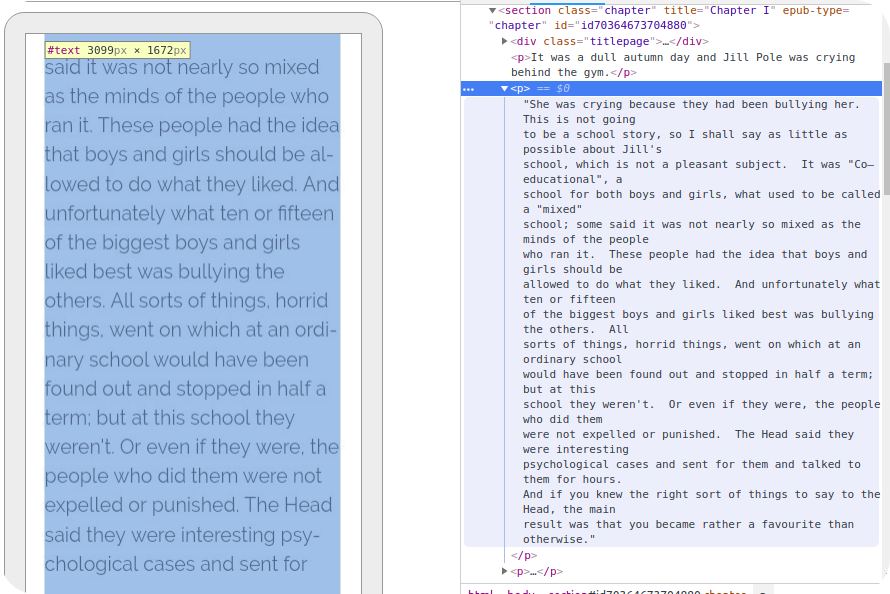
A very important problem caused by unreasonably splitting into overly large paragraphs stems from the CFI standard for marking a reading location in a book, such as bookmarks or highlighted text.
The CFI standard is based on the tree structure of the components in the file, where a location within a chapter is determined by the position of the specific component we are displaying at that moment.
One long paragraph is treated as a single component. And so, placing a bookmark "on" a long paragraph that spreads across several pages will return us to the beginning of that paragraph and not to the page on which we set that bookmark.